


Hereditary hair loss – how to counteract it
Hereditary hair loss is an issue that affects millions of people worldwide. Have you ever wondered why your hair is falling out even though you’ve tried all kinds of shampoos and treatments? The answer could lie in your genes.
According to studies, around 80% of men and 50% of women are affected by some form of hair loss in the course of their lives. The majority of this is hereditary. In the following sections, we will provide you with comprehensive information on this topic.
We talk about symptoms, diagnostic options and conventional treatment approaches. We will also introduce you to an effective and long-term solution: hair transplantation.
What is hereditary hair loss and how does it differ from other forms?
Hereditary hair loss, also known as androgenetic alopecia, is a form of hair loss that is influenced by genetic factors. In contrast to temporary causes such as stress or malnutrition, this form of alopecia is controlled differently. It is mainly caused by a combination of genes and hormones.
This means that if parents or grandparents have suffered from hair loss, the likelihood of being affected increases. This type of hair loss is characterized by typical patterns.
One of the first signs of hereditary hair loss is often the loss of hair on the top of the head or forehead. In men, this often takes the form of a receding hairline or baldness on the crown of the head; in women, it takes the form of thinning hair, mainly around the crown.
One of the main causes of hereditary hair loss is the increased sensitivity of the hair follicles to the male hormone dihydrotestosterone (DHT).
There are of course other types of hair loss, such as circular hair loss (alopecia areata) or diffuse hair loss. But androgenetic alopecia (alopecia androgenetica) is the most widespread.
It is chronic and usually progresses slowly but steadily. This makes early treatment all the more important. The male sex hormone androgen is responsible for this. This shortens the growth phase of the hair.
Symptoms and signs
The first signs of hereditary hair loss can be subtle and often easily overlooked. In men, it often begins with the receding hairline at the temples, also known as receding hairline.
For women the pattern is less noticeable and usually appears as a gradual thinning of the hair. Hereditary hair loss in women often begins in the crown area. Another symptom can be the loss of hair volume, which worsens over time.
A certain amount of hair loss during daily showering or combing is normal. If you find more hair than usual on the pillow or in the brush, you should be concerned.
If you experience these symptoms, it is advisable to consult a doctor or dermatologist. An early diagnosis can not only provide clarity, but also increase the effectiveness of treatment approaches.
Diagnosis and tests: the first step towards solving hereditary hair loss
When you notice the first signs of hair loss, a professional diagnosis is crucial. This will allow the best treatment options to be found. A doctor or dermatologist can carry out various examinations and tests. As a result, the exact type and stage of hair loss can be determined.
This often includes a visual inspection, measurement of hair density and possibly also a hair root analysis. In some cases, blood tests can even be carried out to rule out other possible causes such as hormone imbalances or deficiency symptoms.
Early diagnosis is of great importance. Some therapeutic approaches in the early stages of hair loss are significantly more effective. Therefore, you should not hesitate to seek professional help at the first signs or concerns.
Conventional treatment approaches: not a sustainable solution
Free hair analysis
Click on the button and get your individual treatment price in only 2 minutes!
Why hair transplantation is the effective and long-term solution
Having gone through the conventional treatment approaches, the question arises: is there a more sustainable solution for hereditary hair loss? The answer is yes, and it is hair transplantation.
In this surgical procedure, hair follicles are removed from an area with dense hair growth, usually the back of the head. They are then transplanted into the bald or thinning areas.
The great advantage of this method is its longevity. Unlike medication or tinctures, a hair transplant offers a permanent solution with natural-looking results.
In addition, the recurring costs and possible side effects of long-term medication use are eliminated.
The transplanted hair does not fall out. They are taken from areas that are resistant to hereditary hair loss.
So if you are looking for an effective and permanent solution, a hair transplant is worth considering.
Hair transplant procedure
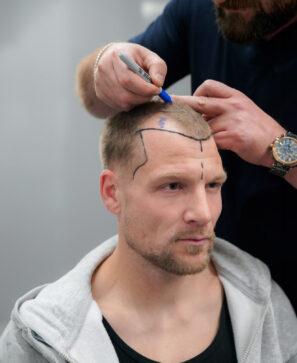
A thorough preliminary examination is carried out first. During this, the suitability for the procedure, the condition of the scalp and the donor area are assessed. After a successful assessment, an individual treatment plan is drawn up.
On the day of the transplant, the hair follicles to be removed are first identified and the area is locally anaesthetized. The follicles are then harvested individually or in small groups and prepared for transplantation.
The recipient sites are also locally anaesthetized before the follicles are implanted. The entire process can take several hours and is usually performed on an outpatient basis.
After the transplant, there is a recovery period. During this time, special care instructions should be followed in order to achieve optimal results. Aftercare is relatively straightforward and the recovery time is short compared to other surgical procedures.
These techniques help with hereditary hair loss
A hair transplant for hereditary hair loss can be performed using many techniques can be carried out. The following methods are particularly effective and gentle at the same time:
- FUE
- Sapphire
- DHI
- SDHI
- Percutaneous
FUE stands for Follicular Unit Extraction and is a minimally invasive procedure. In this method, individual hair follicles are extracted directly from the donor area. These are then transplanted into the balding area. This minimizes scars and speeds up the recovery process.
Sapphire hair transplantation uses special sapphire blades instead of traditional steel blades. This results in more precise incisions and causes less trauma to the scalp. As a result, healing is improved and the risk of complications is reduced.
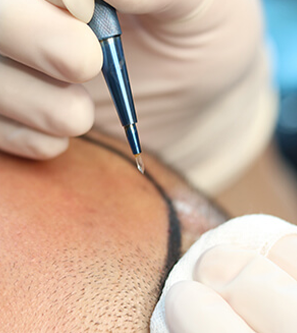
DHI stands for Direct Hair Implantation and is a special method of hair transplantation. A special tool, the Choi Implanter Pen, is used for this.
With this tool, hair follicles can be implanted directly without prior cuts or incisions. This enables a more natural look and shortens the recovery process.
SDHI stands for Sequential Direct Hair Implantation and is a method that combines the best elements of DHI and FUE. The focus of this technique is on minimizing the time the hair follicle spends outside the body. This ensures a higher survival rate of the hair follicles.
Percutaneous is another method of hair transplantation. With this technique, microscopically small channels are inserted into the scalp instead of making incisions or cuts. This allows the hair follicles to be planted closer together. This enables denser and more natural hair growth.
All of these methods offer specific benefits depending on the individual needs and condition of the patient’s scalp. Regardless of the method chosen, however, it is crucial to seek advice and treatment from an experienced and qualified specialist.
Hair transplantation in Germany and Turkey
A hair transplant can be performed in various countries. However, Germany and Turkey stand out as particularly attractive options. In Germany, you benefit from an excellent medical infrastructure, strict quality controls and highly qualified specialists.
Medical training and specialist clinics in Germany are among the best in the world. If you are interested in a hair transplantation in Germany you can be sure that the latest technologies and proven methods will be used.
In addition, the processes are well organized and there is a high level of legal certainty should complications arise.
Turkey, on the other hand, is best known for its cost-effective treatments. In recent years Istanbul to become a global center for hair transplants developed. Not least because of the relatively low costs, which are often only a fraction of the prices in Western countries.
But lower costs do not necessarily mean lower quality. Many Turkish clinics are internationally accredited and employ experienced specialists who are familiar with the latest techniques.
In addition, an all-inclusive package is often offered. This also includes accommodation and transfers to and from the airport. This makes the whole experience particularly convenient.
If you are looking for a cost-effective yet high-quality option, Turkey offers excellent possibilities. Both countries have their own advantages and can be a good choice for your hair transplant.
Why Bank Of Hair is the best choice for your hair transplantation
Now that you know more about hair transplants, you’re probably wondering where you should have the procedure done. Our recommendation is clear: Bank Of Hair.
Why? Because we are characterized by the highest quality standards, experienced specialists and individually tailored treatment plans. At Bank Of Hair, every patient is treated as an individual. The treatment plan is tailored specifically to your needs.
Our modern technologies ensure minimal downtime and natural results. We also offer comprehensive aftercare and advice to ensure you are happy with the final result.
Last but not least, customer satisfaction is a top priority for us, and numerous positive reviews confirm our expertise. If you are looking for a long-term solution for your hereditary hair loss, Bank Of Hair is the answer.
Take your fate into your own hands and declare war on hair loss
Congenital hair loss is a common problem that affects many people, but there are solutions. While conventional treatment approaches often only offer temporary relief, hair transplantation is an effective and long-term solution.
With modern technologies and experienced specialists, Bank Of Hair offers you the opportunity to realize your dream of a full head of hair. Our customized approach ensures that you get the best and most natural results.
So why wait any longer? Take control of your destiny. Contact us today to find out more about the possibilities!
The Bank of Hair is waiting for you!
Are you now well informed and want to take the next step? The good news is that getting started with the hair transplant process is easy. Contact us for a no-obligation initial consultation.
All your questions will be answered during this initial consultation. Your scalp will be examined and a personalized treatment plan outlined. We also offer flexible financing options to make the treatment affordable for everyone.
It’s never been easier to take the initiative and do something about hair loss. Your path to fuller, healthier hair starts with a simple phone call or email. Don’t hesitate any longer and start living a confident life now with our free hair analysis!
FAQ
Hereditary hair loss cannot be stopped completely, but there are treatment options that can slow down the process. A hair transplant is also the right choice to replenish bald patches with new hair.
Medication such as minoxidil or finasteride can slow down hair loss. Hair transplants offer a permanent solution.
Hereditary hair loss can be inherited from both parents. It is often a combination of the genes of both parents.
Typical signs are thinning hair and receding hairlines, especially in men. In women, the overall hair density can decrease.
The onset can vary, but often occurs in adulthood, sometimes even in the late teenage years.
Free hair analysis
Click on the button and get your individual treatment price in only 2 minutes!
Stay up to date

The question of the best time for a hair transplant concerns many people who suffer from hair loss or thinning hair. With the right information and timing, you can not only improve the appearance of your hair, but also increase your self-esteem and quality of life. In
The question of the best time for a hair transplant concerns many people who suffer from hair loss or thinning hair. With the right information and timing, you can not only improve the appearance of your hair, but also increase your self-esteem and quality of life. In

The question of the best time for a hair transplant concerns many people who suffer from hair loss or thinning hair. With the right information and timing, you can not only improve the appearance of your hair, but also increase your self-esteem and quality of life. In
The question of the best time for a hair transplant concerns many people who suffer from hair loss or thinning hair. With the right information and timing, you can not only improve the appearance of your hair, but also increase your self-esteem and quality of life. In
Free hair analysis
Click on the button and get your individual treatment price in only 2 minutes!