


Understanding hair growth
Introduction: Why understanding hair growth is crucial If you are interested in hair transplants, it is important to learn more about hair growth, its different stages and its negative and positive influences. This knowledge will help you to better understand the process and work with our head surgeon at Bank of Hair to develop your personalized treatment.
You should know these three phases of hair growth
- Anagen phase: Most of our hair is in the growth phase, also known as the anagen phase. In this phase, the hair actively grows after a new hair root has formed. The anagen phase lasts around two to six years in human scalp hair. Around 85-90% of the hair on the scalp is in this phase.
- Catagen phase: In this transitional phase, the hair stops growing and prepares to be shed. This phase only lasts a few weeks. The hair detaches from the papilla and atrophies. The hair follicle shortens. Around 1 % of all hairs are in this phase, which are then referred to as “bed hair”.
- Telogen phase: In the resting phase, the hair rests and eventually falls out to make room for new growth. In this final phase, which accounts for up to 18% of the hair on the head, the hair papilla renews itself and the hair follicle regenerates. The matrix is formed again and begins to divide, creating a new hair. This phase of the hair cycle lasts 2 to 4 months. Hair in the telogen phase is called “cob hair”.
These factors influence hair growth
- Genetic factors are certainly among the most important factors influencing hair growth: they play a decisive role in the density and growth cycle of your hair.
- However, hormonal influences can also affect hair growth: Hormones such as dihydrotestosterone and testosterone can influence hair growth. As we now know, an excess of DHT, for example, can lead to hair loss.
- In addition to genetic and health factors, lifestyle also plays an important role in the health of your hair. We now know that the effects of stress on the hair follicle are transmitted via specific pathways in the nervous system. Each hair follicle or hair follicle is surrounded by a dense network of nerve fibers containing messenger substances from the nervous system. Stress increases the number of nerve fibers in the skin. If this increase takes place while hair follicles are changing from the growth phase to the transition phase, mast cells are activated. This triggers inflammation in the area of the hair follicle. This leads to programmed cell death in the hair follicle tissue and ultimately to hair loss. We therefore advise all patients before and after hair transplantation to reduce stress – through sport, exercise, a healthy diet and even meditation.

The right diet for healthy hair
Did you know that your diet has a major influence on the health and growth of your hair? A balanced diet with vitamins, minerals and proteins is essential for strong and shiny hair. Vitamins such as biotin and vitamin A are particularly important, as is the mineral iron. Biotin, also known as vitamin B7, plays an important role in healthy hair and nails. It supports hair growth and strengthens the hair structure. A biotin-rich diet is simple: eggs, nuts, seeds, pulses, oatmeal, carrots and avocados contain a lot of biotin.

How do transplanted hairs grow healthy and strong?
The path to healthy, strong hair does not end with the transplant; the healing process and the integration of the transplanted hair require careful aftercare to ensure that the hair is not disturbed in its growth. We therefore advise our patients to avoid all hair-stressing activities for the time being – e.g. smoking or alcohol, which not only jeopardize wound healing but also hair growth.” (More on smoking and hair transplants). Otherwise, the transplanted hairs behave quite normally – most of them are always in the important growth phase. You can support them through appropriate nutrition.
Stay up to date

The question of the best time for a hair transplant concerns many people who suffer from hair loss or thinning hair. With the right information and timing, you can not only improve the appearance of your hair, but also increase your self-esteem and quality of life. In
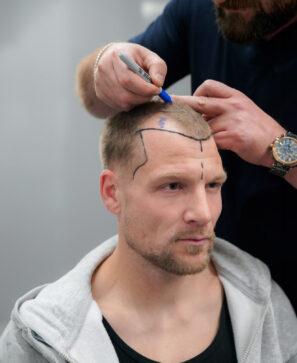
The question of the best time for a hair transplant concerns many people who suffer from hair loss or thinning hair. With the right information and timing, you can not only improve the appearance of your hair, but also increase your self-esteem and quality of life. In

The question of the best time for a hair transplant concerns many people who suffer from hair loss or thinning hair. With the right information and timing, you can not only improve the appearance of your hair, but also increase your self-esteem and quality of life. In

The question of the best time for a hair transplant concerns many people who suffer from hair loss or thinning hair. With the right information and timing, you can not only improve the appearance of your hair, but also increase your self-esteem and quality of life. In
Free hair analysis
Click on the button and get your individual treatment price in only 2 minutes!